Two scholars to publish first-ever biography
The following excerpt is from the Introduction to Quaintance: The Short Life of an American Art Pioneer, a biography by Ken Furtado and John Waybright, to be published in 2004. The authors can be contacted at kfurtado@surfbest.net or waybrightj@earthlink.net.
![]() |
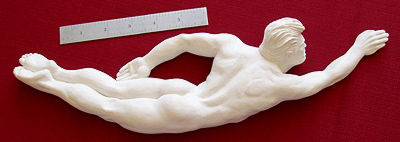
| One of six sculptures from the series "Neptune's Children" courtesy of ONE Institute |
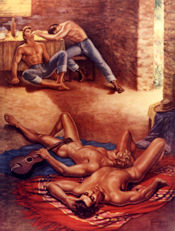
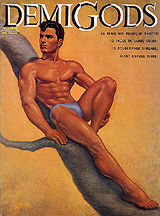
From the 1920s to the 1950s, the phenomenon that was George Quaintance blazed a trail across the American cultural landscape that is long overdue for renewed recognition.
![]() |
| "Siesta" oil on canvas 1952 courtesy Tom of Finland Foundation |
Using a pseudonym, Quaintance also drew pinup girls for the covers of pulp and movie fan magazines of the 1920s and 1930s, most often Movie Humor, Tempting Tales, and Movie Merry Go-Round. In 1937, he was the highest-paid illustrator for Gay French magazine, earning more than $50,000. As such, he was a forerunner to such later masters of the female pin-up, as Vargas.
![]() |
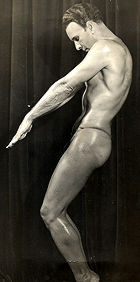
| George Quaintance courtesy Finter-Salvino archive |
Quaintance was the first artist to eroticize Levi's, long before they became an icon of American culture or an emblem of one's sexuality. Quaintance also fetishized the cowboy look, effecting it himself in his later years, almost as if in anticipation of the cowboy's later assimilation into gay culture. And before politics knew the difference between correct and incorrect, Quaintance's paintings celebrated Mexican, Native American and Central American peoples and images.
While others prated about the love that dared not speak its name, Quaintance quietly revealed its face, and showed it to be simple, masculine and brave. Perhaps some of that can be traced to the years Quaintance spent writing for bodybuilding publications, photographing and painting bodybuilders and judging the occasional bodybuilding competition.
![]() |
| Quaintance watercolor of body builder Glenn Bishop |
George Quaintance was a bridge between two generations of gay sensibility, an embodiment of what writer Douglass Shand-Tucci, in The Crimson Letter, calls "The Warrior Archetype." The Warrior Archetype, of which American poet Walt Whitman is the prototype, conflates masculinity and eros into an esthetic of manliness which may include gay sex but which does not reduce to gay sex. Historical parallels would be the Japanese Samurai tradition and the ancient Greek concept of warrior-lovers, the latter of which strongly informs many Quaintance paintings.
![]() |
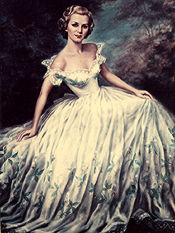
| Mrs. Victor Moore, life-sized wearing a gown by Adrian courtesy Tom of Finland Foundation |
Quaintance's male physique paintings are the apotheosis of this twentieth century sea-change, in which casual nudity among men becomes so expressive and so connotative with never a cock to be seen as to assume a potency previously associated only with pornography.
That would all change radically, and soon. Within a year of Quaintance's death, a new force emerged on the erotic landscape by the name of Tom of Finland. Tom who cites Quaintance as one of the artists who influenced his drawing drew images so exaggerated and so sexually explicit they made Quaintance seem, well, quaint by comparison.
Before Quaintance, erotic masculine images were hardly to be found except in the arts of ancient Greece and Rome, underground images from Europe, and the works of a few bold painters and photographers such as Wilhelm von Gloeden, F. Holland Day, Paul Cadmus and Thomas Eakins. Soon afterwards, there was hardcore porn, and the VCR.
In this narrow window of time and opportunity, Quaintance found a niche that earned him fame, wealth and recognition, even if within only a small sphere of influence. His paintings today are so scarce and highly desired, they pass from collector to eager collector without ever being offered on public art markets. His sculptures are even harder to find. And the photographs that he mass-produced and sold for $1.00 each through his mail-order business now fetch $150 on ebay.
Whether or not George Quaintance is a name you are familiar with, we invite you to turn the page and, for the first time in print, meet the man behind the image.